Why Isn't My Website Bringing In Customers?

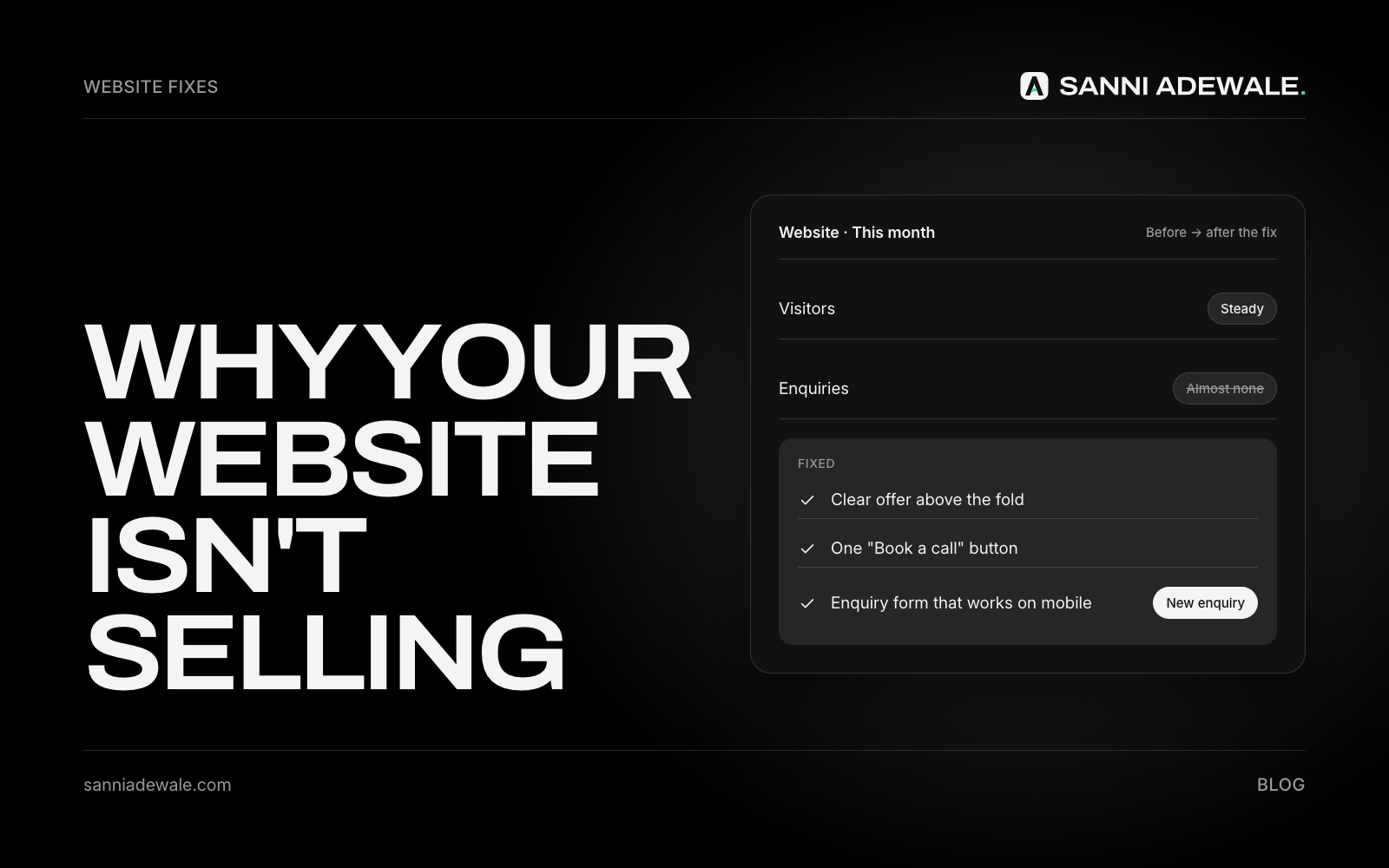
Short answer: Most small-business websites don't bring in customers for three reasons: the right people can't find them, visitors can't quickly tell what you do and why you, or there's no easy way to get in touch or book. Usually it's all three. The fix is a site built around how your customers buy, and that's what we build for you.
"The website looks fine, so why is nobody calling?"
It's one of the most common things owners tell us. You paid for a website, it looks professional, maybe a friend or an agency built it a few years ago. But the enquiries come from word of mouth and repeat customers, not from the site. It feels like an online brochure that nobody reads.
That's not bad luck. A website brings in customers only when it does three jobs at once: gets found, convinces and converts. Most sites were built to look good, which is a fourth job and the least important one.
Why does this happen?
Nobody's finding it
If your site doesn't clearly say what you do, where you do it and for whom, Google has little to match it to real searches. Google's own SEO starter guide is built around one idea: make content that's helpful and clearly describes what people are looking for. A homepage that says "Quality solutions since 2009" doesn't tell Google (or a customer) that you're an electrician in Leeds.
Visitors can't tell what you do in five seconds
People skim. If the first screen is a stock photo and a vague slogan, they leave and click the next result. They want to know: is this what I need, do they cover my area, can I trust them, what happens next?
There's no clear next step
The contact page is buried, the form asks for 12 things, there's no booking link, no price guide, and the phone number isn't tappable on a mobile. Every bit of friction loses a share of people who were ready to buy. Usability researchers at Nielsen Norman Group found that people look for contact details in the top right corner or the footer, and that companies which hide them are seen as evasive and unreliable.
Nothing proves you're good
No reviews on the page, no photos of real work, no faces, no examples. Visitors compare you with two or three others, and the site with proof usually wins.
It's slow or broken on a phone
Most local searches happen on phones. If your site loads slowly or the buttons are tiny, people give up. (More on this in Is your slow website costing you customers?)
What is it costing you?
A website that doesn't convert costs you twice. First, the customers who found you and left without contacting you; you'll never know their names. Second, the money you then spend elsewhere to make up for it: ads, directory listings, time spent chasing referrals. Meanwhile, competitors with clearer sites quietly collect the enquiries you should have had.
Signs you need help
Most of your enquiries come from word of mouth, not the website
You don't know how many people visit or what they do on the site
Your contact form rarely gets used, or only gets spam
You can't update the site yourself, so it's out of date
It doesn't show up when you search for your service and town
Your site was built more than three or four years ago and hasn't been touched
You're embarrassed to send people to it
What does "fixed" look like?
Before | After |
|---|---|
Vague slogan on the homepage | Says what you do, where and for whom in one line |
Contact page buried in the menu | Call, book or quote button on every screen |
Long contact form | Short form or booking link that takes under a minute |
No reviews or examples | Real reviews, photos and short case examples up front |
One page for every service | A clear page for each service people search for |
Slow and awkward on a phone | Fast, easy to use with one thumb |
No idea what's working | Simple tracking: visits, calls, form fills and bookings |
Enquiries go unanswered for hours | Instant reply and follow-up (see Follow up every lead automatically) |
What to ask a web provider before you hire one
How will the site bring in enquiries, not just look good?
Which searches should it show up for, and how will you set that up?
What will a visitor see first on a phone?
How will I know how many calls, forms and bookings the site brings in?
Can I update text, photos and services myself afterwards?
Who owns the site, the domain and the content?
If the answers are all about colours and fonts, keep looking.
How we fix it
We start by looking at your site the way your customers do: how they find it, what they see first, and where they drop off. Then we rebuild or rework it around getting found and getting enquiries, with clear service pages, proof, fast mobile pages, booking and instant replies, and simple tracking so you can see what it brings in. You get a site that works as a salesperson, not a brochure, and you don't have to learn any of it yourself.
FAQ
Why does my website get visitors but no enquiries?
Usually because visitors can't quickly see that you do what they need, there's no proof you're good, or contacting you takes too much effort. A clear message, real reviews and an obvious call or booking button fix most of it.
Why isn't my website showing up on Google?
Often the pages don't clearly describe your services and location, there's one page trying to cover everything, or the site is slow and thin on content. Google needs clear, helpful pages that match what people search for.
How long does it take to fix a website that doesn't convert?
It depends on the starting point. Quick fixes to messaging and contact options can be done in days; a proper rebuild around your services usually takes a few weeks.
Do I need a new website or can mine be fixed?
Sometimes the existing site can be reworked; sometimes the platform holds it back and a rebuild is faster and cheaper long term. A review of how it's built and what it needs to do answers that.
How do I know if my website is working?
You should be able to see how many people visit, and how many call, fill in a form or book. If you can't see those numbers, that's the first thing to fix.
Want us to fix this for you?
Send us an email at Lexxy0905@gmail.com or book a call.