Get the Business Out of Your Head: Turn What You Know Into Simple SOPs With AI

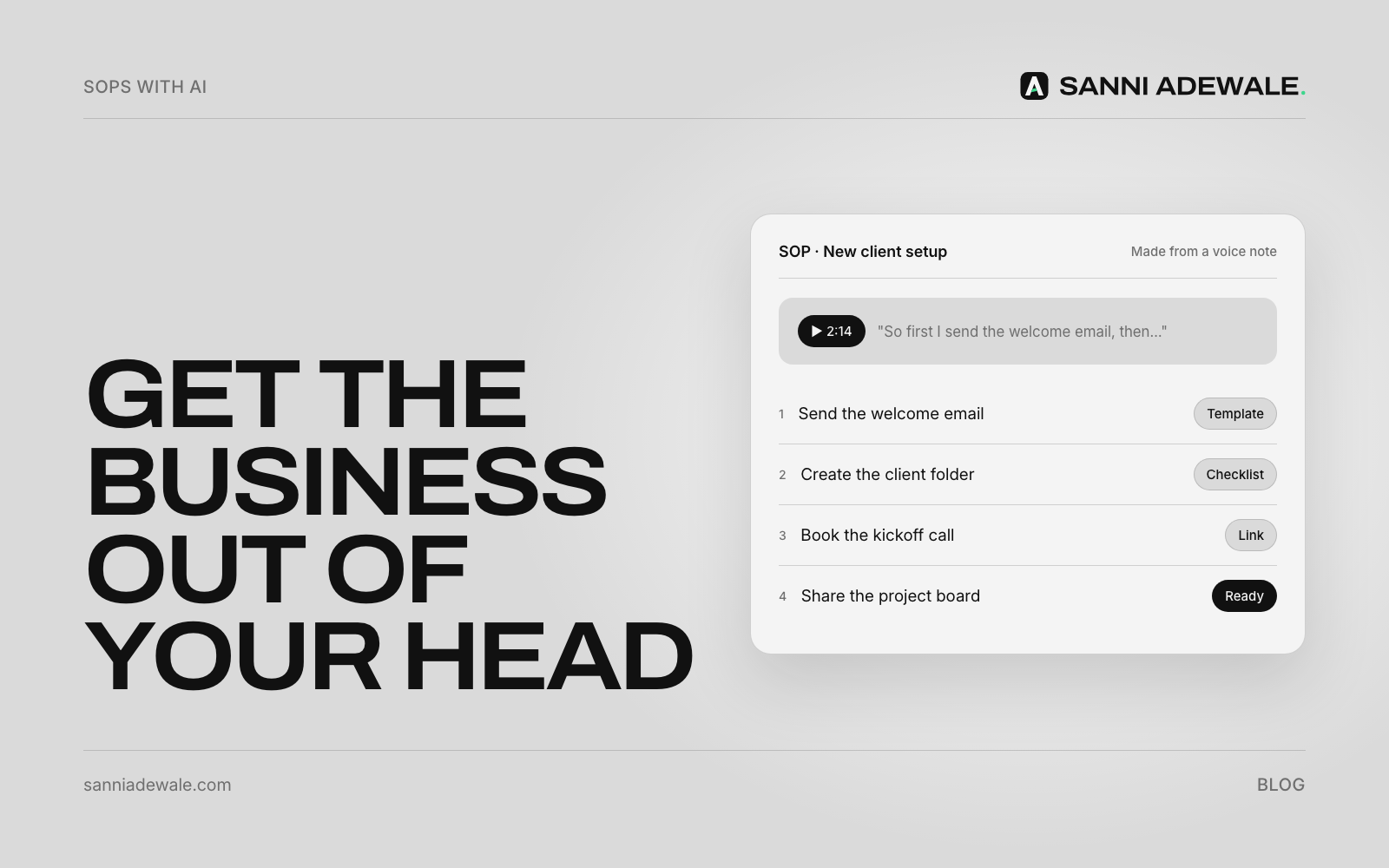
Short answer: To get the business out of your head, record yourself doing a task once (talking it through or sharing your screen), let AI turn the transcript into a short step-by-step SOP or checklist, then have someone else follow it and fix the gaps. Start with the tasks that break first when you're away.
The problem: everything depends on you remembering
A question doing the rounds in small-business groups this month: if you stepped away for 30 days, what would break first? The answers were honest. Follow-up. Answering new enquiries. Pricing decisions. The little client details, like "text before you arrive" or "there's a dog by the side gate."
The common thread is that the knowledge lives in the owner's head. And as one owner put it, nobody wants to sit and write processes after a full day.
That's the part AI changes. You no longer have to write the SOP. You just have to do the task once while talking, and let AI do the writing.
What a good small-business SOP looks like
Forget 40-page manuals. A useful SOP for a small team fits on one screen:
What it's for: one line ("Reply to a new quote request").
When to use it: the trigger ("A new enquiry arrives by form, email or phone").
Steps: 5–10 numbered actions, each starting with a verb.
Rules and judgement calls: "If the job is under X, quote from the price list; if over, book a site visit."
Done looks like: how you know it's finished.
How to do it: 7 steps
1. List what breaks when you're away
Ask yourself the 30-day question and write down the first five things. Most owners land on: answering enquiries, sending quotes, following up, invoicing and onboarding a new customer.
2. Record yourself doing the task once
Do it for real and talk out loud as you go. For computer tasks, use a screen recorder such as Loom or the built-in recorder on your computer; for phone or on-site tasks, use a voice memo. Don't tidy it up. Say the "why" as well as the "what": "I always check the postcode first because we don't go past the ring road."
3. Get a transcript
Most recording and meeting tools can produce a transcript, or you can paste the audio into a transcription tool. You want plain text of everything you said. Some tools go a step further: Loom's AI workflows can turn a recording into a step-by-step document, and tools such as Tango capture screen steps as you click. For tasks away from a screen (opening up, packing orders, an on-site check), a voice memo on your phone works just as well.
4. Let AI turn it into an SOP
Paste the transcript into an AI assistant such as ChatGPT or Claude with a prompt like:
"Turn this transcript into a one-page SOP for a small team. Include: purpose, trigger, numbered steps starting with verbs, decision rules, and what 'done' looks like. Keep my wording for any rules. Flag anything unclear as a question."
The "flag anything unclear" line matters. It surfaces the bits you do on autopilot and never explain.
5. Write down your judgement calls
The hardest knowledge to hand over is judgement: when to discount, which jobs to turn down, how to handle an unhappy customer. Answer the AI's questions, and add your rules in plain language. These rules are often worth more than the steps.
6. Test it on someone else
Give the SOP to a team member (or a friend) and watch them follow it without help. Every time they hesitate, that's a missing step. Fix it on the spot.
7. Store SOPs where people work, and put an owner on each
Keep them in one shared place: a Google Drive folder, Notion or your project tool, named by task ("Reply to a new enquiry"). Give each SOP an owner and a "last checked" date. Once your SOPs exist, they become the knowledge an AI assistant can answer from (more on that in Answer customer questions even when you're busy).
SOP checklist
☐ Top five "what breaks first" tasks listed
☐ Each task recorded once, talking through the why
☐ Transcript turned into a one-page SOP by AI
☐ Decision rules and judgement calls written in your words
☐ AI's questions answered
☐ Tested by someone else, gaps fixed
☐ Stored in one shared folder, named by task
☐ Owner and "last checked" date on each SOP
☐ Customer-specific notes kept with the customer record
Which tasks to document first
Task | Why it breaks without you | Format that works |
|---|---|---|
Replying to a new enquiry | Only you know the answers and prices | SOP + saved reply templates |
Sending a quote | Pricing rules live in your head | SOP + price rules table |
Following up | Nobody remembers to chase | Checklist + automated reminders |
Invoicing and chasing payment | Easy to forget when busy | SOP + automatic reminders |
Starting a new customer | Steps get skipped | Checklist |
Client-specific details | Lost when someone covers a shift | Notes on the customer record |
From SOPs to automation
Once a task is written down, it's much easier to automate. Follow-up can become an automatic sequence, chasing payments can become automatic invoice reminders, and daily admin can go to an AI assistant. The SOP comes first; the automation follows it.
FAQ
What is an SOP for a small business?
An SOP (standard operating procedure) is a short, written set of steps for a task you do repeatedly, such as replying to an enquiry or sending a quote. It lets someone else do the task the way you would.
Can AI write SOPs for me?
Yes. Record yourself doing the task while talking it through, get a transcript, and ask an AI assistant to turn it into numbered steps with decision rules. You still need to check it and add your judgement calls.
Which processes should I document first?
Start with whatever breaks first when you're away, usually answering enquiries, quoting, following up, invoicing and starting new customers. These touch revenue and customer experience directly.
How long should an SOP be?
For a small team, one page or one screen is usually enough: a purpose, a trigger, 5 to 10 steps, any decision rules and what "done" looks like. Longer documents rarely get used.
How do I keep SOPs up to date?
Give each SOP an owner and a "last checked" date, and update it whenever someone gets stuck following it. A quick review every few months keeps them accurate.
Do SOPs make my business more valuable?
A business that runs without the owner remembering every step is easier to grow, hand over and step away from. Written processes are a big part of that.
Want something like this for your business?
Send us an email at Lexxy0905@gmail.com or book a call.